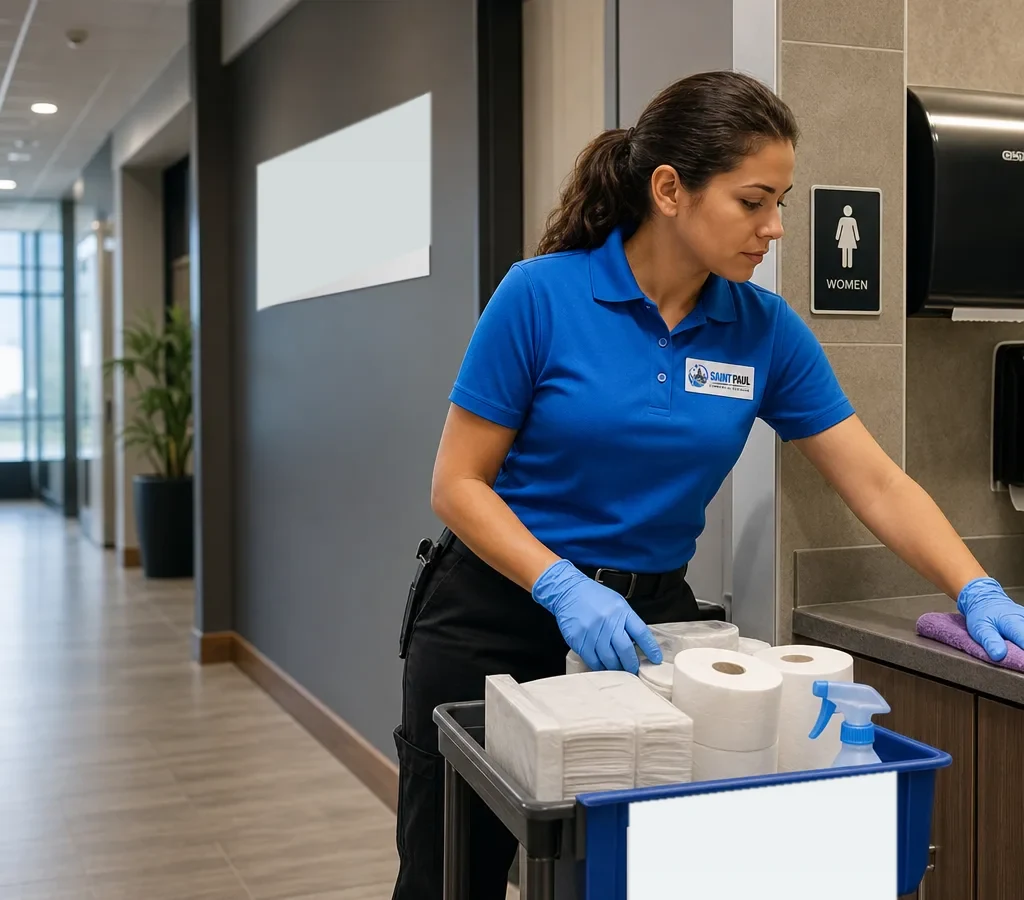
Commercial cleaning technician in a Saint Paul workplace

Janitorial services in Saint Paul

Janitorial Services Saint Paul

Janitorial service is most useful when recurring responsibilities are written around a building’s daily use, access windows, and agreed priorities.

Service overview

Give Everyday Building Care a Clear Owner

Routine work becomes hard to manage when nobody has defined what “handled” means. A trash area is assumed to be covered. A shared kitchenette is noticed only when it is not. A restroom, entry, or common surface falls between separate expectations. Janitorial service gives a facility a way to organize those recurring responsibilities around the spaces people use every day.

For Saint Paul offices, retail suites, and shared commercial buildings, the focus is a repeatable scope rather than an impressive-sounding checklist. The facility can describe its rooms, priorities, access limitations, and the work it wants addressed on an ongoing basis. A written scope makes it easier to review the routine and see where it needs refinement.

Clear ownership also makes it easier to distinguish a routine from a changing facility need. A newly used room, a shift in how a common area is shared, or a condition that has developed over time can be raised against the existing scope. That is more useful than assuming a recurring service covers every possible task. The facility has a shared reference point for discussing what belongs in everyday care and what should be considered separately.

Janitorial service is one part of a broader facility plan. A manager looking at building-wide recurring priorities can review commercial cleaning in Saint Paul. If accumulation has moved beyond the usual routine, a separate deep-cleaning discussion can help distinguish a defined reset from the daily work that repeats.

Request an Estimate
Service details

What a Clear Scope Covers

Recurring room responsibilities

A janitorial plan can assign attention to the rooms and shared areas that repeatedly need care. The important step is to name the agreed work for each area rather than treating the building as one undifferentiated space.

Shared-space upkeep

Entrances, break areas, restrooms, and common rooms have different patterns of use. A useful scope identifies the shared spaces that matter most and the condition the facility wants to maintain.

Waste and recycling boundaries

Collection points and related tasks should be discussed in the context of the facility’s layout and existing arrangements. The scope should be clear about what is included instead of implying broad handling responsibilities.

Floors and visible details

Carpeted areas, mats, hard floors, and high-use surfaces can be noted as part of the recurring routine when they are within the agreed scope. Separate condition issues may call for a different conversation.

A practical planning conversation

How a Repeatable Janitorial Routine Takes Shape

01

Map the daily-use spaces

Start with the areas occupants and visitors use regularly, including common rooms, restrooms, entries, and agreed work areas.

02

Name the recurring tasks

Turn priorities into a written list of room-specific responsibilities so the routine has something concrete to follow and review.

03

Clarify access windows

Discuss when agreed areas are available and any building boundaries that shape the service plan.

04

Revisit the scope when use changes

If occupancy, layouts, or priorities change, the written routine gives the facility a starting point for an informed update.

Where Recurring Janitorial Service Fits

  • ✓Office buildings with common areas, kitchens, and restrooms.
  • ✓Retail and service locations with regular customer traffic.
  • ✓Multi-tenant properties with shared entries and corridors.
  • ✓Professional suites that need everyday care organized around defined rooms.

Common questions

Janitorial Services Saint Paul: FAQs

What is the purpose of a janitorial service scope?+

It turns recurring needs into agreed responsibilities. The scope can identify the rooms, shared areas, tasks, access considerations, and priorities that matter to the facility instead of relying on general expectations.

Does every building need the same janitorial routine?+

No. An office, a retail suite, and a multi-tenant property can use similar categories of work while needing different priorities. The scope should reflect how the building is actually used.

What if some cleaning needs are not recurring?+

A facility can separate routine janitorial care from a one-time or condition-based need. Deep cleaning or floor care, for example, may need its own defined conversation rather than being assumed within the regular plan.

What should we share before requesting an estimate?+

Describe the type of facility, the areas you want considered, daily-use concerns, and any access or timing limits. That helps make the estimate discussion specific without requiring you to predict every task. It is also useful to describe the relationship between shared areas and private work zones, along with any locations that are not part of the request. These boundaries keep a recurring routine understandable for the facility. They make room for an estimate discussion that is based on normal building use, clear responsibilities, and the practical choices that affect everyday care.

Request an estimate

Discuss recurring janitorial care that matches the way your Saint Paul building is used.

Request an Estimate

Request an estimate

Tell Us About Your Facility

Share a few details about your commercial cleaning needs and we will follow up about the right scope for your space.