
Entry Doors, Glass, Thresholds, And Walk-Off Mats
Entry doors and walk-off mats take everything the street brings in. Once mats saturate with salt and slush they stop working, and the grit moves straight into the common areas behind them.
Serving Saint Paul, Minnesota & surrounding areas
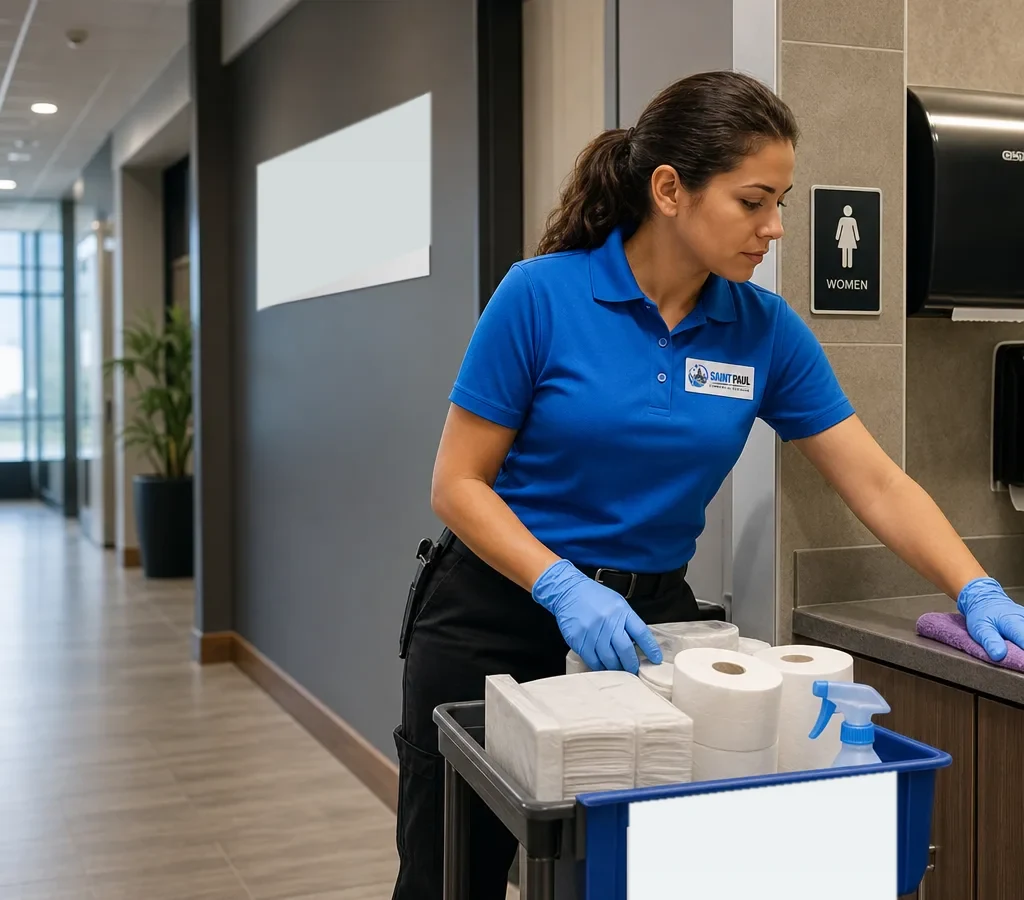
Industry-specific cleaning in Saint Paul
Retail and shopping center cleaning in Saint Paul for entries, common areas, restrooms and customer-facing surfaces. Define priorities around traffic, tenant boundaries and access.
Industry overview
Retail and shopping-center cleaning should be scoped around customer flow: entries, common areas and the spaces that see the most visible use. Visitors experience a property in sequence, from the approach and entry through corridors, shared restrooms and customer-facing surfaces. That makes a long, generic list of tasks less useful than an agreed set of priorities for the areas the property manager or retailer is actually responsible for.
A Saint Paul retail scope can distinguish tenant-controlled spaces from common-area work without assuming a particular shopping center, footfall pattern or operating schedule. The estimate conversation can identify entries, corridors, restrooms, accessible floors, glass and waste points, together with the access limits that apply to each. This gives the facility a practical way to discuss visible traffic pressure and shared-area boundaries while retaining flexibility for the way the site operates.
Request an EstimateScope and tasks
Entry doors and walk-off mats take everything the street brings in. Once mats saturate with salt and slush they stop working, and the grit moves straight into the common areas behind them.
Customer restrooms and common corridors are shared by every tenant and owned by none of them. Naming tasks and frequency here prevents the standard drifting between busy and quiet weeks.
Food-court and seating areas, where they apply, collect spills and crumbs faster than any other common space. They need a rhythm matched to peak trading, not a single daily pass.
Accessible floors, waste points, and high-touch surfaces are visible to every shopper. Setting their cadence in advance keeps them from becoming a reactive fix after a complaint.
A practical process
01
We walk the property and find the friction points: the entry that never looks right in winter, the corridor nobody has clearly owned, the restroom that slips at weekends.
02
You get the plan in writing, separating common-area responsibility from tenant space with named tasks and frequencies, so the boundary is documented rather than assumed.
03
We agree when crews can work, so cleaning happens outside trading hours or in quieter windows instead of around shoppers.
04
We revisit the plan as trade changes. A holiday period and a slow February put very different pressure on entries, corridors, and seating areas.
Common questions
We start with what is going wrong now, not a standard list. The scope names entries, common corridors, customer restrooms, and agreed shared areas, with tasks and frequency for each.
Yes. Cleaning around shoppers creates its own problem. We set the service window around trading hours, usually before opening, after close, or during a quieter stretch.
Access is agreed up front and written into the scope: which common areas are included, what keys or codes apply, and where tenant responsibility begins.
Tell us the size of the common areas, what is not working now, when we can get in, and whether you need recurring service or a one-off reset. That is enough to scope it.
Request an estimate
What usually goes wrong
Retail cleaning problems concentrate in the spaces between tenancies. Each store looks after its own floor, and the corridors, entries, and shared restrooms in between belong to everyone in principle and no one in practice. That is where standards drift, and where shopper complaints usually start.
Winter makes the entry the weak point. Salt and slush arrive on every pair of boots, saturate the walk-off matting, and then travel into corridors and seating areas. Mats that are not managed as part of the plan stop doing their job within days, and the problem multiplies across the whole property rather than staying at the door.
The second issue is timing. Cleaning around shoppers is slow, disruptive, and visibly unfinished, but working purely after close can leave a long gap during peak trading when restrooms and food-court seating need attention most. A workable plan usually mixes an out-of-hours routine with defined checks during the day.
We write down which common areas are covered, at what frequency, and where tenant responsibility begins, so the boundary is documented rather than argued about later. For heavier surface work, the floor care and window cleaning pages set out how those projects are scoped.
Request an estimate
Share a few details about your commercial cleaning needs and we will follow up about the right scope for your space.