
Lobby Seating, Entry Glass, And Customer-Facing Surfaces
A branch lobby is judged in the first ten seconds. Handprints on entry glass, dust on seating, and marked counters undercut the impression of care that a financial institution depends on.
Serving Saint Paul, Minnesota & surrounding areas
Industry-specific cleaning in Saint Paul
Financial institution cleaning in Saint Paul for public-facing areas, offices, restrooms and agreed accessible spaces. Define a scope around privacy boundaries, access and the operating day.
Industry overview
Financial-institution cleaning begins with an access boundary, not an assumption that every room is available. A lobby, reception space, public restroom or meeting area may need a consistent standard for visitors, while workspaces can have different rules for access and timing. A useful scope separates the areas that are open to customers from agreed accessible offices and common spaces, so the plan reflects the way the facility actually operates.
That approach keeps privacy practical rather than theatrical. The estimate conversation can identify the visible areas, the access limits the site sets and the times a space is available, without implying access to records, secure rooms or controlled workspaces. The written scope then states what is included and what needs separate instruction. It gives a Saint Paul branch or financial office a clearer basis for discussing commercial cleaning around public presentation and defined boundaries.
Request an EstimateScope and tasks
A branch lobby is judged in the first ten seconds. Handprints on entry glass, dust on seating, and marked counters undercut the impression of care that a financial institution depends on.
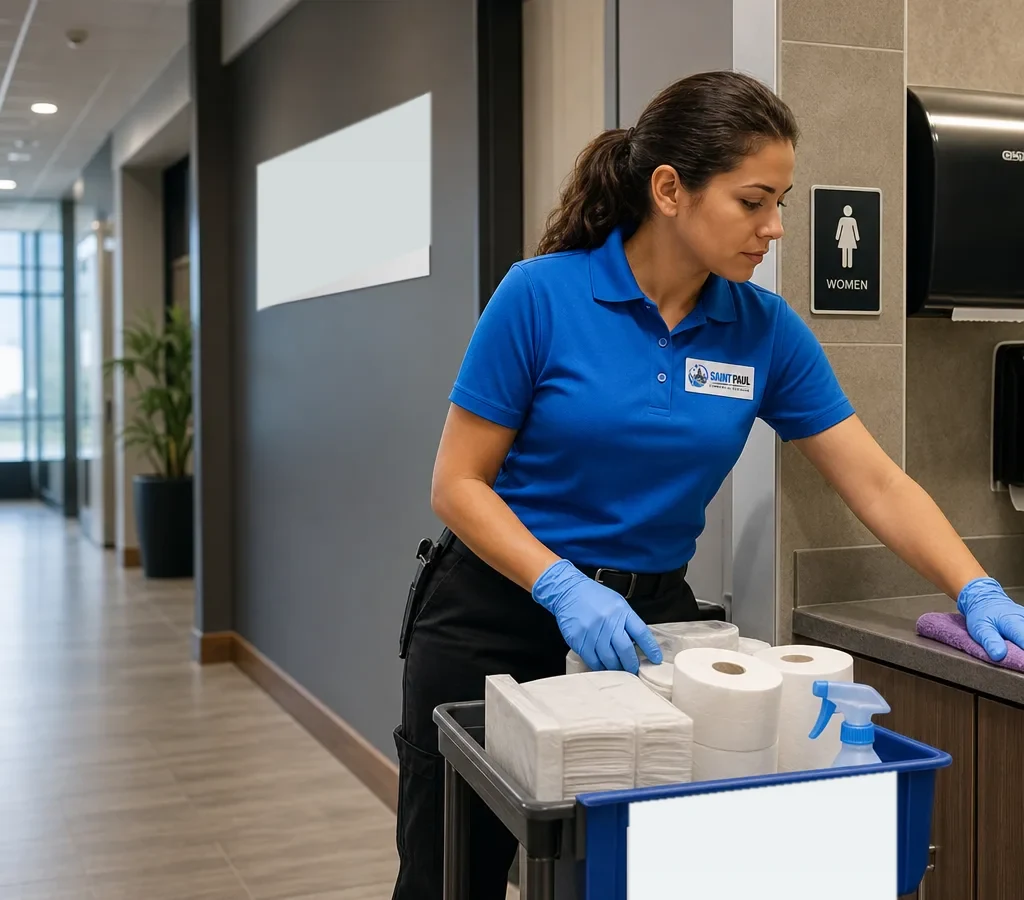
Public and staff restrooms are the space customers quietly use to gauge standards. Fixtures, mirrors, dispensers, and the floor around fittings are named so they hold up through a full day.
Offices, break rooms, and shared work areas sit behind the counter but affect staff every day. They get their own frequency instead of waiting for a quiet week that never comes.
Floors, mats, and waste points in agreed zones carry the visible wear. Winter grit and steady foot traffic are handled deliberately rather than as part of a general pass.
A practical process
01
We walk the branch and note the real issues: entry glass that never stays clear, a lobby that looks tired by afternoon, areas where responsibility has never been clearly assigned.
02
You get the plan in writing, naming public-facing spaces and agreed accessible offices with tasks and frequencies. Secure areas stay outside the scope unless separately agreed in advance.
03
We agree when crews can be on site, so cleaning happens outside banking hours and never in front of waiting customers.
04
We revisit the plan as conditions change. A Minnesota winter puts far more pressure on entries and floors than a quiet summer month, and the scope should reflect that.
Common questions
We start with what is going wrong now, not a standard list. The scope names the lobby, public restrooms, accessible offices, and agreed shared areas, with tasks and frequency for each.
Yes. Cleaning in front of customers works against the impression a branch needs. We set the service window around your banking hours, usually before opening or after close.
Access is agreed up front and written into the scope: which areas are available, what entry procedures apply, and which secure spaces stay outside the arrangement entirely.
Tell us the size of the branch, what is not working now, when we can get in, and whether you need recurring service or a one-off reset. That is enough to scope it properly.
Request an estimate
What usually goes wrong
Financial institutions have an unusual cleaning problem: much of the building is restricted, so a generic scope either promises access it will never get or leaves obvious public areas underspecified. The result is a lobby that looks acceptable and a set of shared staff spaces that nobody has clearly owned for months.
The public side carries the reputational weight. Customers form a view of an institution from the entry glass, the seating, and the restroom, and those are exactly the surfaces that show handprints and wear fastest. A branch that is cleaned on a general rota, rather than by named area and frequency, tends to look fine early and tired by mid-afternoon.
Access is the constraint that makes or breaks the plan. Secure areas cannot be treated as available, and cleaning cannot happen while customers are being served. Agreeing entry procedures and a service window in advance is what keeps the arrangement workable instead of a standing negotiation at the door.
We name the public-facing spaces, the agreed accessible offices, and the boundaries around everything else, then set a frequency for each. Nothing is assumed to be included. Where a condition needs more than routine attention, the deep cleaning and floor care pages explain how that work is scoped separately.
Request an estimate
Share a few details about your commercial cleaning needs and we will follow up about the right scope for your space.